True Crime and Border Deaths
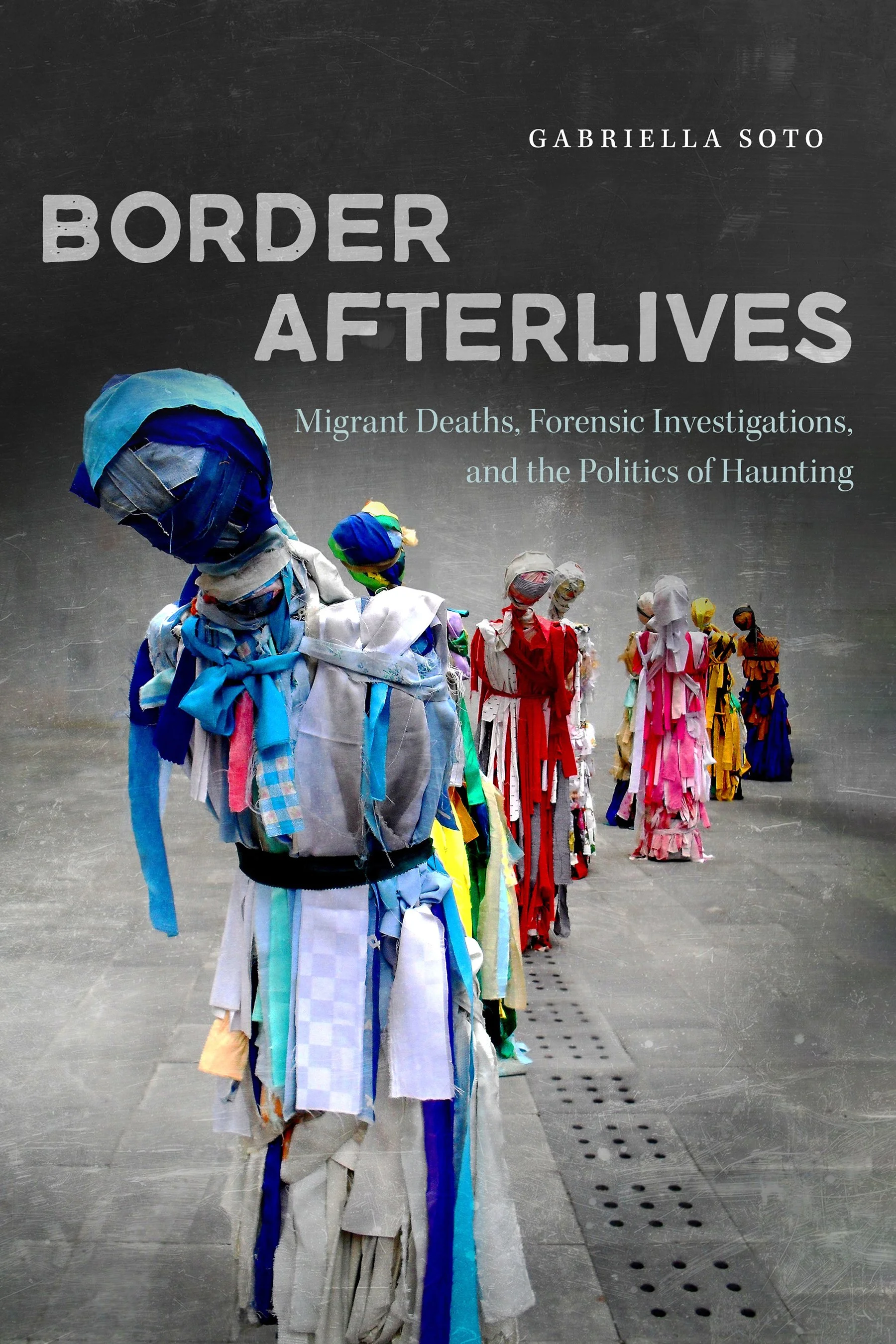
Border Afterlives focuses on migrant border-crossing mortality, how and why these deaths occur, and the often inadequate forms of forensic death investigation this population receives in the aftermath. Many of the thousands who have died during border crossings in the US southwest remain unidentified due to lack of effort and infrastructure.
By Gabriella Soto
While finishing my book, Border Afterlives: Migrant Deaths, Forensic Investigations, and the Politics of Haunting, I dragged my partner to bookstores across the Phoenix area to help me think about what people are reading and the possible marketing angles for attracting general audiences to the heavy topic of investigating migrant border crossing deaths. My book is academic, but it’s also one that I hope can reach beyond the academy. It was no surprise that social science literature was not well-represented in popular bookstores, and the small sections I found related to this genre included entries like the autobiographies of recent US presidential contenders. Besides cooking, self-help, various genres of fiction, and children’s literature, true crime offerings constituted walls of books prominently on display. Clearly, this genre moves inventory. My partner joked, “maybe you should try to rewrite your book as true crime.” We both laughed, and then I couldn’t stop thinking about it.
I’ll admit that I’ve always been disgusted by the genre, my impression being that it is alternately exploitative and disproportionately fixated on pretty white blondes. There’s even a popularized name for this fixation: “missing white woman syndrome.” As a scholar focused on the deaths and disappearances of undocumented people, it’s frustrating that a missing white woman can command media attention, and even political action, in a way that thousands of undocumented people, missing and murdered Indigenous women, and Black Americans—all disproportionately represented among the nation’s missing and unidentified—cannot (Davis 2023; Stump 2021; US GAO 2022).
In 2022, the Help Find the Missing Act, or Billy’s Law, passed through the US Congress, designed to close the loopholes that render these populations disproportionately represented among the nation’s missing and unidentified dead. But it wasn’t the tireless lobbying of the border-based humanitarian groups working on behalf of undocumented travelers that led to the bipartisan embrace of this important legislation—Billy’s Law had actually languished in Congressional limbo as a bill since 2007. It was the family of Gabby Petito, a beautiful white, blonde woman who went missing after she was murdered by her fiancé in 2020 (Ruiz 2022).
Her story is a tragedy and I cannot imagine the anguish of her family, both losing someone so young and enduring that awful period of waiting for answers. I also can’t imagine seeing a personal tragedy filtered through the mediascape as entertainment. In no way is my disappointment that Petito’s family moved the needle on this legislation a suggestion that her tragedy doesn’t matter. In no way do I deny that tragic cases are any less tragic based on the phenotype or social status of those involved, but that’s one way to interpret the disproportionate popular fixation on white women like Petito—the public treats her death as if it matters more than those who happen to have a different color skin.
The media’s months-long coverage of Petito’s case meant that it was made into a law-enforcement priority; their experience eventually gave the family entrée to lawmakers on Capitol Hill who were able to move this bill to passage (Ibid.). Her family’s involvement in the passage of Billy’s Law also reveals something else. Even if it’s exploitative, this popular attention is powerful in real and direct ways; the Petito’s story is politically legible and could be leveraged into action. Petito’s family follows precedent set by the family of the actress, Sharon Tate, whose advocacy led to all 50 US states eventually adopting a Victims’ Bill of Rights, and the 2004 federal passage of the Crime Victims’ Rights Act (Vargas 2017). The reporting on these developments name Tate “the face of victims’ rights.” Tate was also a beautiful, blonde, white woman, who was pregnant at the time of her gruesome murder at the hands of followers of the infamous Charles Manson in 1969. After Tate’s death, her mother and aunt worked tirelessly to ensure that none involved in the deaths of Sharon and her companions would ever receive parole (Ibid.).
The story of the AMBER Alert—referring to America’s Missing: Broadcast Emergency Response—stems from the abduction and unsolved murder of a white child, Amber Rene Hagerman, in Texas in 1996. In the aftermath of Amber’s death, her parents lobbied for the Texas legislature to create more protection for child victims, leading eventually to the passage of the federal law, the Amber Hagerman Child Protection Act, which instituted the National Sex Offender Public Registry. The registry website was re-named for Dru Sjodin in 2006. Dru was another beautiful white woman who was killed in 2002, with the man eventually charged and convicted for her death found to be an already a registered sex offender (“About Dru” 2023). With the passage of the PROTECT Act in 2003, federal institutionalization of AMBER alerts was established through the National Center for Missing and Exploited Children (OJP 2023).
In California in the 1990s, the kidnappings and deaths of two young white women, two years in a row, resulted in political leverage to pass the draconian three-strikes sentencing laws mandating a minimum sentence of 25 years for any third offense if any previous convictions were aggravated or violent. This was despite the fact that prior to the sensationalized coverage of these two events, law-makers had considered this measure unjustifiably harsh (Nichol 2024).
So, as expressions of what occupies the popular imagination and in turn, as vehicles that reveal certain sociological truths, there is something fascinating about what takes hold as popular crime and tragedies profiled in the popular true crime literary and media genre.
The central thesis of my book is that the deaths and disappearances of those who endeavor to cross into the United States through clandestine channels along the nation’s southwest border should haunt the American public; they should capture our imagination; they should provide a powerful point of leverage for wide scale reforms in postmortem investigations; and provoke us to question how we understand security. Why are those inordinately policed the ones who are most at risk? Ultimately, the story of undocumented border crossers who die is an ongoing true crime story, even as I doubt it could never find a home in genre true crime.
Good victims
True crime scholar, Jean Murley (2008), described some of the central pillars of most true crime stories. Almost universally, they begin with the story of the crime itself, complete in graphic detail, followed second by profiles of the killer (when known) and victim.
Of the killer: What drives a person to kill? Who do they target? Why? What does the making of a criminal mind reveal about the social forces that forged it?
Of the victim: Antemortem and postmortem details of the person whose life was ended reveal the scope of the crime’s social impact with a story of the life or lives lost and the marks such lives leave on those who survive them. This has been noted as a newly progressive component of the genre intended to emphasize the life of the deceased beyond the terrible way that life ended.
These narratives end with a story of the legal process—often fraught—of bringing killers to justice…or not. Sometimes, they end with a mystery, or with a critique of a justice system that failed.
With these components in conversation, there seems to be a holistic, even anthropological, structure to these narratives. These indicate not just interpersonal stories of tragedy, but stories of the society from which these tragedies emerge. And yet, these narratives are also packaged as lurid entertainment—the more painful, grisly, or mysterious, the better. Perhaps it’s true, as some argue, that these honor victims’ memories and support families, but they also undeniably exploit them (cf. Nichol 2024). This genre is also racialized, concerned with relatively affluent or predominantly white places where crime is far from the norm. They seem to reinforce a tough-on-crime political outlook that visualizes such people and places as in need for urgent protection. It’s not a tragedy if the death or investigation occurs in a place or among a population where crime is more common. But the insinuation is that this insecurity is okay, even normal, and even—drawn to its most damning logical conclusion—that certain populations are more prone to crime. It plays out in analysis of crime investigation. An Omaha police chief affirmed that homicide solve rates are “one of the best indicators of how well a police department and a community work together. [….] If a police department can’t solve the greatest crime, the most egregious crime affecting society, what faith would you have in that police department?” (Lowery et al. 2018).
Yet, a Washington Post report on homicide resolution rates in major cities across the United States, broken down by census tract, revealed that murders were less likely to be rigorously investigated in poorer and less white areas. It didn’t matter if those census tracts were cleanly segregated from others, or whether the city was more or less racially or socioeconomically integrated. Poorer, browner census tracts were consistently less likely to have homicides within their boundaries resolved. Inordinately, homicides in those neighborhoods are both more prevalent and less likely to result in a police investigation (Ibid.).
Police interviewed for the story attested that it wasn’t worth it to investigate those deaths because no one would talk to the police anyways, insinuating that everyone in such neighborhoods had something to hide: “These are not innocent victims,” said one former police chief (Ibid.). There was a strong tone of apathy in these interviews—what’s the point of even trying in such places? It echoes some of the ethos I uncovered in years of research on postmortem investigations on behalf of migrants along the border—an underlying attitude of, what’s the point?
I think a lot about a wide-scale psychological survey that took place in the United States around the first election of Donald Trump, involving interviews with a range of people about demographic shifts based on projections from the latest census, indicating that by 2050 this country’s population will be majority minority and mostly Latinx. Self-identified white people will no longer be the dominant group. The study considered people’s reported social issues of concern before and after the topic of demographic change was brought into conversation, as a neutral event, and separately described with a positive spin. Survey results found that any mention of these demographic projections resulted in people reporting more politically conservative positions than they had initially, across an array of political themes, but especially on racialized issues like immigration policies (Craig et al. 2018). The team’s analysis, recording results through 2016, suggested that “white identity politics is likely to reemerge in overt and explicit forms as the racial diversity of the nation increases” (Ibid.: 210-211). This is strong evidence of the same sort of normative values promoted by true crime. White people, especially white women, need protection.
There’s a host of literature on what makes a good victim. A good victim has to be innocent in the truest sense of the word—pure, guileless, and uncorrupted by nuance (cf. Goldsmith 2022; Ticktin 2017). Murley (2008) argued that the genre originated with the disappearance of the English baby girl, Virginia Dare, with the lost Roanoke Colony in present day Dare County (so-named in honor of baby Virginia), North Carolina in the 16th century. She was the perfect victim as a white baby reliant on others for her care, without true agency to have been a part of the conversations about joining a risky colonial expedition from Britain to the new colonies (Rosner 2021).
There’s a reason why migration scholars reacted with a degree of discomfort in 2015 when the images of the body of the two-year-old Syrian boy, Alan Kurdi, washed up on a Turkish beach captured the attention of the global public. On the one hand, his death forced the public to confront the terrible risks and losses imposed on undocumented people attempting to reach the borders of the European Union via the Mediterranean Sea. But the focus on the child’s tragic death emphasized his lack of choice in his family’s migration journey, and all but ignored the deaths of his mother and older brother that occurred on the same journey. Public opinion was eventually mobilized against the bereaved father for smuggling his family (Khan 2015).
There’s a reason why those known as DREAMers in the United States have made an effort to distance themselves from the component of the political drive towards formalizing their immigrant status over that of their parents. The story goes, the DREAMers, as agency-less children, entered the United States without authorization “through no fault of their own.” As children, they were innocent—good victims (Gomberg-Muñoz 2016).
Miriam Ticktin (2011, 2017) has considered the politics of asylum seekers in France, who have learned to emphasize their victimhood in just the right way to conform with these narratives, to cast themselves as victims in need of Europe’s protection. The more injured the better. Sexually abused women invoke too much grey nuance for a culture pervaded by lingering forms of implicit misogyny, and so such forms of victimization have been undermined in asylum claims.
Maybe there’s untapped potential in the true crime market to bring structural issues to light regarding the lapses in forensic infrastructure and lacking standards to guide investigations. Yet, a review of migration and refugee stories that have captured media attention or popular sympathy seem to revolve around sensational details, eventually dovetailing into destructive categorization of the victimized into good or bad, deserving and undeserving (Edkins 2016; Goldsmith 2022; Robbins 2013; Squire 2014; Ticktin 2017). But these tropes will always break down; they defy the messiness of being human.
Maybe the market can handle direct violence and individual deaths, but I imagine a system as a killer would be harder to swallow. The true crime market reverts to sensationalism and easy tropes, but what’s happening is more akin to Arendt’s concept of the banality of evil. Her claim that high-level Nazi operative Adolf Eichmann was a monster, just not quite as he was narratively portrayed, drew audiences at the time to anger. It wasn’t that Eichmann was a foaming-at-the-mouth killer, it’s that he was a rigidly conforming rule follower and that’s what made him a perfect creature of the Nazi regime…and so terrifying (Arendt 2006 [1963]). The killer here is not extraordinary, or an aberration. It’s legalized murder, sanctioned by the system in which we live. How do you disrupt that?
And yet, for all of this, true crime might also provide direction for disrupting the status quo and empowering those whose voices have been silenced.
If I suppress my disgust, I notice that the genre overwhelmingly tells stories about domestic violence directed at women. Until recently, domestic violence was not legally recognized; terms like “marital rape” did not exist. Domestic violence claims were long ignored, seen as lacking credibility because they came from women (Hale 2024).
Only in 2022 was the so-called “boyfriend loophole” closed, for unmarried partners subject to restraining orders to be prevented from obtaining handguns (Treisman 2022). The #MeToo movement that started in earnest in 2017 put the scope of quotidian violence faced by women in the workforce into relief. Women have been aware of these forms of violence for a long time through their own lived experiences, but they were not openly discussed (North 2018).
There’s speculation that the true crime genre exists because crimes against women are so quotidian they are otherwise marked by silence (Hale 2024; Murley 2008; Winter 2012). In this sense, there’s potential. This genre also represents a counter-narrative conveyed by the marginalized for self-preservation and truth-telling. True crime is a space of truth spectacularized to convey a deeper message for those capable of recognizing the subtext, especially women trying to understand the minds of their male everyday attackers. You can read it safely if the men in your life dismiss it as pulp. True crime is about packaging the lesson in a form that gets to those who need it (Hale 2024).
True crime as counternarrative
A connection seems to exist between true crime as a subversive genre to tell the story of violence against women by women and for women and transgressive histories of racial oppression. We can’t ignore that the true crime genre has also historically excluded, and further marginalized stories of non-white and non-gender conforming, advancing instead a kind of normative white womanhood as worthy of grief. But true crime also holds lessons for uplifting these stories (Goldsmith 2022).
In The Injustice Never Leaves You, Monica Muñoz Martínez (2018) explained how stories of violence against Tejanes[1] have long been the province of vernacular history exchanged intergenerationally by families as parables, circulated outside of the halls of the Academy.
“Meeting official histories with a healthy dose of skepticism is widespread practice for racial minorities and marginalized groups in Texas. Chicana cultural theorist Rosa Linda Fregoso described learning to question Texas history when she was young. She remembered that in her eighth grade Texas history course, the instructor gave ‘heartwarming’ lectures on Anglo-Mexican struggles for Texas’ independence and juxtaposed Anglos as ‘noble’ with Mexicans described as ‘villainous.’ While Fregoso learned at school about ‘the cruel streak in Mexican nature,’ at home her father introduced her to alternative accounts of the past. In her analysis of Pilar Cruz, the leading Tejana character in the film, Lonestar, Fregoso writes that the character of countermemory of Tejas put her ‘in touch with a long tradition of opposition to racist discourse, with popular forms of knowledge, transgressive tales of resistance, subaltern practices of suspicion of official versions of history.’” (266-67)
This observes how sanctioned and school taught historical discourse not only contains omissions, but elevates certain normative and exclusionary versions of the past. To disrupt this normativity—especially that circulated as truth in a middle school classroom—one needs to circulate one’s own stories.
Chicana historian and activist, Raquel Rubio-Goldsmith (2016) has worked to consider such counternarratives as a serious basis for historical production—a still somewhat radical position in the Academy. She notes that such counternarratives are not only vehicles of truth, but underground resistance (cf. Trouillot 1995).
Speaking of violence in a history of Mexicanes, this time in the border city of Douglas, Arizona, Rubio-Goldsmith (2016) defended the truth passed down generationally in parables of violence.
“Positivistic, or, shall I say, scientific history demands a narrative based on official or at least hegemonic sources—an analysis of the archive. Yet the sources of this narrative are the memories and stories transmitted to me by persons all too familiar with the ways in which violence is lived— the ways in which they remember, I suggest, shed light into the silences of the past and are, in fact, a vivid trace. [….] On the border, inhabitants at times resist [injustice and legalized violence against them] publicly, but often resistance takes the form of narratives some popular lessons and guides to the present, and others underground shouts of frustration. The positivist historical method is ill equipped to work these grounds.” (28-29, 30)
On the border, the scholarly project has been to try to formalize accounts of the hidden story of what’s happening to undocumented people who die in transit. Those involved in this research are creating an academic counternarrative. It would be anathema to this record to say there has been any distorting of the facts to tell a wider truth. It is to reclaim the truth from a partial and biased official record. In telling something true, we are displacing destructive norms about who needs security and who is worthy or unworthy of grief. This is the difference between true crime and conveying parables of racial violence.
But maybe we also need to embrace the magical realism of this ongoing tragedy, and how it haunts us. There’s still something here for which a positivist method can’t account. And yet I have often found myself stymied working with my blunt positivist instruments: Here’s where, how, when it all happened. In my writing, I have tried to embrace the spirit of true crime as a counternarrative—not to exaggerate or exploit the truth, but to capture its “vivid traces” that elude the traditional methods of reporting.
So as counternarrative, sometimes dismissed, maybe my book does belong in the true crime genre after all. But I doubt it will ever find a home in the true crime section of my local Barnes and Noble.
Works Cited
About Dru. (2023). Dru Sjodin National Sex Offender Public Website. https://www.nsopw.gov/about-dru
Arendt, H. (2006). Eichmann in Jerusalem: A Report on the Banality of Evil. Penguin.
Craig, M. A., Rucker, J. M., & Richeson, J. (2018). Racial and Political Dynamics of an Approaching “Majority-Minority” United States. The ANNALS of the American Academy of Political and Social Science, 677(1), 204–214. https://doi.org/10.1177/0002716218766269
Davis, S. (Director). (2023). Missing White Woman Syndrome and the Media Bias Towards Missing People of Color [Broadcast]. In All Things Considered. NPR. https://www.npr.org/2023/06/10/1181526829/missing-white-woman-syndrome-the-media-bias-towards-missing-people-of-color#:~:text=It%20refers%20to%20the%20media's,disappearances%20of%20people%20of%20color.&text=IFILL%3A%20If%20there's%20a%20missing,to%20cover%20that%20every%20day.
Edkins, J. (2016). Missing Migrants and the Politics of Naming: Names Without Bodies, Bodies Without Names. Social Research, 83(2), 359–389.
Goldsmith, C. S. (2022). Hope Despite Horror: Theorizing Oppositional Horror and Aesthetics of Resistance in Multicultural Horror [Doctoral Dissertation]. Arizona State University.
Gomberg-Muñoz, R. (2016). Hardship Politics: The Strategic Sharing of Migration Stories. Journal of Contemporary Ethnography, 45(6), 741–764.
Hale, K. (2024). The Dark Origins of the True-Crime Frenzy at CrimeCon. Vanity Fair, July 8. https://www.vanityfair.com/style/story/crime-con-true-crime-report
Khan, A. R. (2015). Alan Kurdi’s father on his family tragedy: ‘I should have died with them.’ The Guardian. https://www.theguardian.com/world/2015/dec/22/abdullah-kurdi-father-boy-on-beach-alan-refugee-tragedy
Lowery, W., Kelly, K., Mellnik, T., & Rich, S. (2018). Where Killings Go Unsolved. Washington Post, June 6. https://www.washingtonpost.com/graphics/2018/investigations/where-murders-go-unsolved/?noredirect=on&utm_term=.bb3ece78c0cb
Muñoz Martinez, M. (2018). The Injustice Never Leaves You: Anti-Mexican Violence in Texas. Harvard University Press.
Murley, J. (2008). The Rise of True Crime: 20th-Century Murder and American Popular Culture. Praeger.
Nichol, A. (2024). My Sister Was Murdered 30 Years Ago. True Crime Repackages Our Pain as Entertainment. New York Times.
North, A. (2018). The #MeToo movement and its evolution, explained. Vox, October 11. https://www.vox.com/identities/2018/10/9/17933746/me-too-movement-metoo-brett-kavanaugh-weinstein
Office of Justice Assistance. (2023). About AMBER Alert. US Department of Justice. https://amberalert.ojp.gov/about
Robbins, J. (2013). Beyond the suffering subject: Toward an anthropology of the good. Journal of the Royal Anthropological Institute, 19(3), 447–462. https://doi.org/10.1111/1467-9655.12044
Rosner, H. (2021). The Long American History of “Missing White Woman Syndrome.” The New Yorker, October 8. https://www.newyorker.com/news/q-and-a/the-long-american-history-of-missing-white-woman-syndrome
Rubio-Goldsmith, R. (2016). Reflecting upon Violence, Injustice, and Impunity in Southeastern Arizona. In R. Rubio-Goldsmith, C. Fernández, J. K. Finch, & A. Masterson-Algar (Eds.), Migrant Deaths in the Arizona Desert: La vida no vale nada (pp. 27–49). University of Arizona Press.
Ruiz, M. (2022). President Biden signs bipartisan missing persons bill backed by Gabby Petito’s family. Fox News, December 29. https://www.foxnews.com/us/president-biden-signs-bipartisan-missing-persons-bill-backed-gabby-petitos-family
Squire, V. (2014). Desert ‘trash’: Posthumanism, border struggles, and humanitarian politics. Political Geography, 39, 11–21.
Stump, S. (2021). Gabby Petito case raises question: Why don’t missing people of color get more attention? Today, September 24. https://www.today.com/news/gabby-petito-case-raises-question-dont-missing-people-color-get-attent-rcna2247
Ticktin, M. (2017). A world without innocence. American Ethnologist, 44(4), 577–590. https://doi.org/10.1111/amet.12558
Ticktin, M. I. (2011). Casualties of Care: Immigration and the Politics of Humanitarianism in France. University of California Press.
Treisman, R. (2022). The Senate gun bill would close the “boyfriend loophole.” Here’s what that means. NPR. https://www.npr.org/2022/06/23/1106967037/boyfriend-loophole-senate-bipartisan-gun-safety-bill-domestic-abuse
Trouillot, M. R. (1995). Silencing the Past: Power and the Production of History. Beacon Press.
US Government Accountability Office. (2022). Missing or Murdered Indigenous Women: New Efforts Are Underway but Opportunities Exist to Improve the Federal Response (No. GAO-22-104045). US Government Accountability Office. https://www.gao.gov/assets/gao-22-104045.pdf
Vargas, T. (2017). How Sharon Tate became the face of victims’ rights. The Washington Post. https://www.washingtonpost.com/gender-identity/how-sharon-tate-became-the-face-of-victims-rights/
Winter, Y. (2012). Violence and Visibility. New Political Science, 34(2), 195–202.
[1]Tejanes refers to Mexican people who became Texans when it became a country from 1836-1846. It was annexed by the United States in 1845 and incorporated as a new state from 1846. Where Spanish language genders its nouns with “o” or “a” the appending of “e” at the end makes the word gender neutral. The same principle applies to the “Mexicanes” below.
